Exeter City Football Club is a professional association football club based in Exeter, Devon, England. The club competes in EFL League Two, the fourth tier of English football, following relegation in the 2025–26 season. Known as "the Grecians", the origin of their nickname is subject to speculation and debate. The club is owned by its supporters through the Exeter City Supporters' Trust.
Exeter City was founded in 1901 and began playing their games at St James Park, where they remain to this day. They joined Division One of the Southern League in 1904. After a tour of South America in 1914 to generate awareness of football in the continent, the club became the first side to play a national team from Brazil. As a result, City and Brazilian side Fluminense are now also partner clubs. Exeter were invited to help create the Football League Third Division in 1920. They were assigned to the Third Division South the next year and won the Third Division South Cup in 1934. They remained in the division until becoming founder members of the Fourth Division in 1958. They were promoted in 1963–64, only to be relegated after two seasons. They were promoted out of the Fourth Division again at the end of the 1976–77 season and managed to stay in the Third Division for seven seasons before being relegated in 1984.
Exeter City F.C. was formed from two predecessor clubs, Exeter United F.C. and St Sidwell's United. Exeter United was a football club from Exeter, Devon, that played between 1890 and 1904. In 1904, Exeter United lost 3–1 to local rivals St Sidwell's United and after the match it was agreed that the two clubs should become one. The new team took the name Exeter City and continued to play at Exeter United's ground, St James Park, where Exeter City still play today. Exeter United was formed from the cricket team of the same name and were one of the first football teams with the moniker "United". St Sidwell's United (which had also been known as St Sidwell's Wesleyans and St Sidwell's Old Boys) was a club that had formed from the regulars who frequented the Foresters Inn in Sidwell Street, Exeter, although the public house was always known as the Drum and Monkey. The team played in St Sidwell's old colours of green and white.
On 10 September 1904, Exeter City played its first ever competitive match, a 2–1 victory at St James over 110th Battery of the Royal Artillery, in the East Devon League. The attendance was 600, and the winning goal scored by Sid Thomas, who was to serve the club in various capacities for seventy years. City topped the East Devon League with eleven wins, two draws and one defeat in its first season, and transferred to the Plymouth & District League for next three seasons. In 1908, Exeter City A.F.C. became a limited company. City became a full-time professional team, and applied successfully for membership of the Southern League, replacing Tottenham Hotspur.
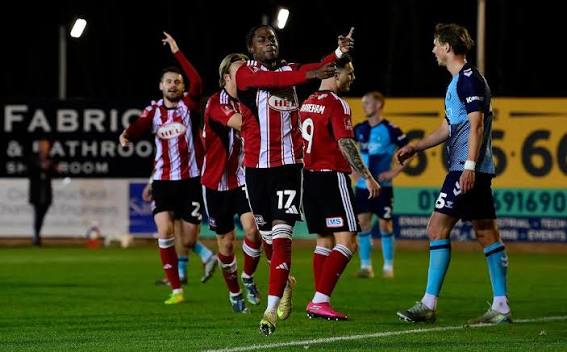
A wooden grandstand was erected, and the club entered into a leasing arrangement over the ground. On 3 October 1908, City recorded its record FA Cup win by beating Weymouth 14–0. The match was in the first qualifying round. James "Daisy" Bell scored six goals and ten of the goals came in the first half. City changed to its current colours of red and white in 1910. This was after having had a poor start to the season (only two wins out of eleven). City abandoned its supposedly unlucky green and white kit, and turned out for the first time in red and white striped shirts at home to West Ham United on 12 November. The result of the game was a 0–0 draw, but five consecutive league wins came for the club in December, and the change of colours stuck.
City made an historic tour of South America in 1914, during which time it played eight matches against teams of Argentina and Brazil. The last match on this tour on 21 July 1914 was an encounter with the first Brazil national football team playing under the authority of a national football association, in this case the Federação Brasileira de Sports, precursor of today's Confederação Brasileira de Futebol, founded just the month before. Brazil, featuring its first great star, Arthur Friedenreich, won this match at the Laranjeiras stadium, Rio de Janeiro, home of Fluminense Football Club with 2–0. The tour yielded five wins, one draw and two defeats. The only other loss was in a match that kicked off 12 hours after the players got off the boat. Exeter City were invited by the Football League to become founder members of the Third Division in 1920.